|
This website itself is made with ATHENA.
NEW: Try ATHENA in your browser
With web-accessible ATHENA, you can experience ATHENA desktop without downloading or installing anything. Open a temporary remote ATHENA session at https://athweb.evalisk.org/ and start exploring ATHENA directly in your browser.
Each session runs in its own isolated environment and is temporary. The environment is automatically reset when the session ends, so download anything you want to keep before leaving.
1Introduction
ATHENA, i.e. the Advanced Typesetting and Hypertext Environment for Notes and Archives, is a math-centered knowledge workstation derived from GNU TEXmacs, combining structured WYSIWYG typesetting with vault-based knowledge organization and inter-connectivity needed by large mathematical note collections.
ATHENA is not for everyone. Use it only if you are disappointed with both LATEX and Obsidian. ATHENA is not a LATEX editor, not yet another Obsidian clone, and not a conservative TEXmacs distribution. It is an experimental research workstation and mathematical knowledge infrastructure. It assumes that you want semantic mathematical documents, native typesetting, cross-document structure, vault-wide operations, and deep customization more than you want broad ecosystem compatibility.
If plain Markdown is enough, use Obsidian. If batch typesetting and source-text control are enough, use LATEX. ATHENA exists for the uncomfortable middle: interactive mathematical writing at scale.
ATHENA 0.5 extends the vault into a more connected mathematical workspace: native commutative diagrams, structural document comparison, neighborhoods and reference graphs, fuzzy structural search, semantic Artifacts, stronger LATEX round trips, and optional Codex and encrypted RAG delegation.
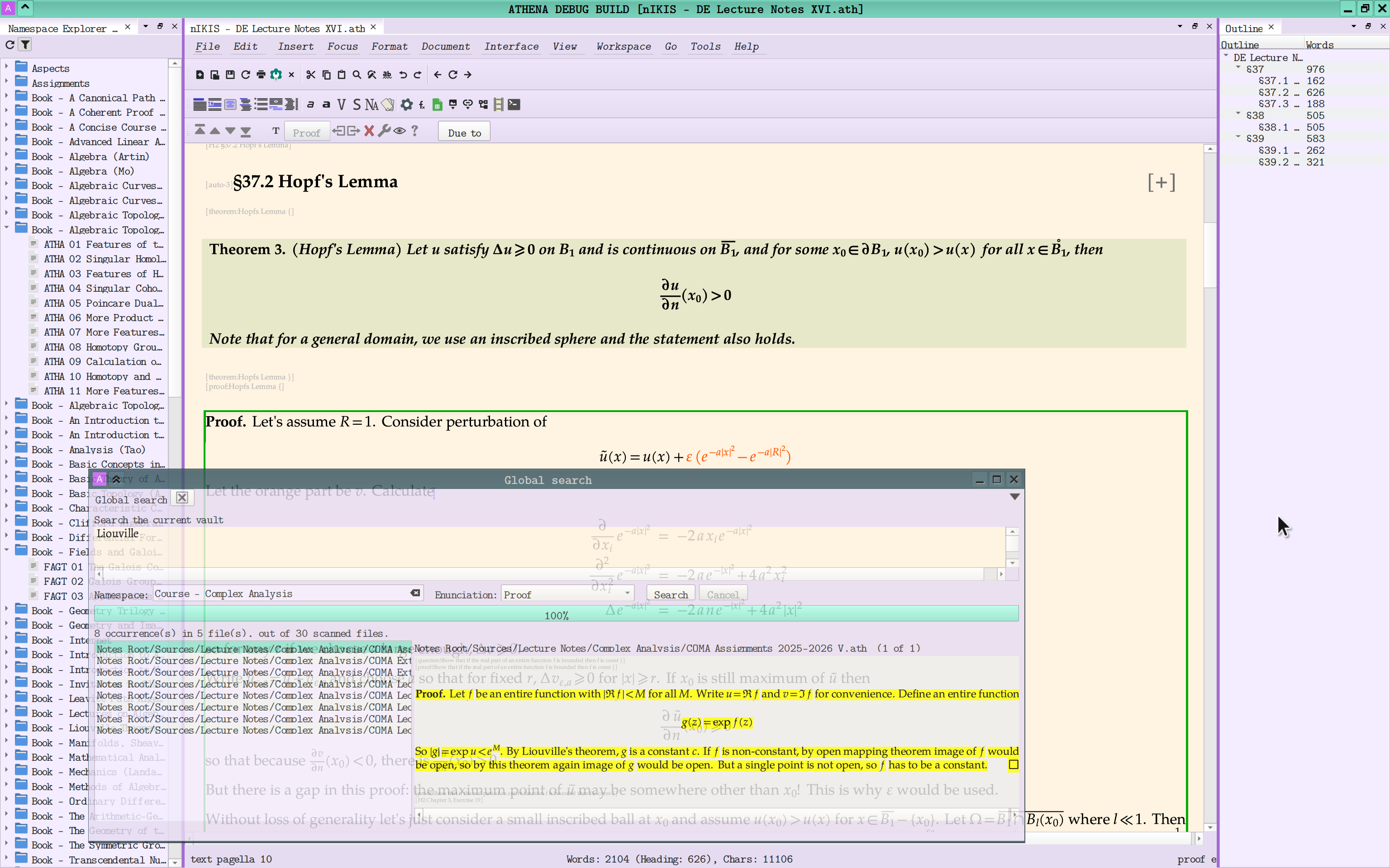
ATHENA in action, showing a document, namespace explorer, global search and outline.
ATHENA grew out of a long attempt to maintain a serious mathematical vault. The first versions were not editors, but tools around Obsidian: exporters, indexers, metadata generators, a Markdown dialect, and a compiler supporting wikilinks, transclusions, and structured callouts. These tools eventually showed that the real problem was not conversion. The vault, the mathematical document, the search system, and the publishing pipeline needed to belong to one environment.
ATHENA is that environment: a TEXmacs-based mathematical knowledge system with vaults, namespaces, theorem anchors, search, transclusion, maintenance tools, and static website publishing.
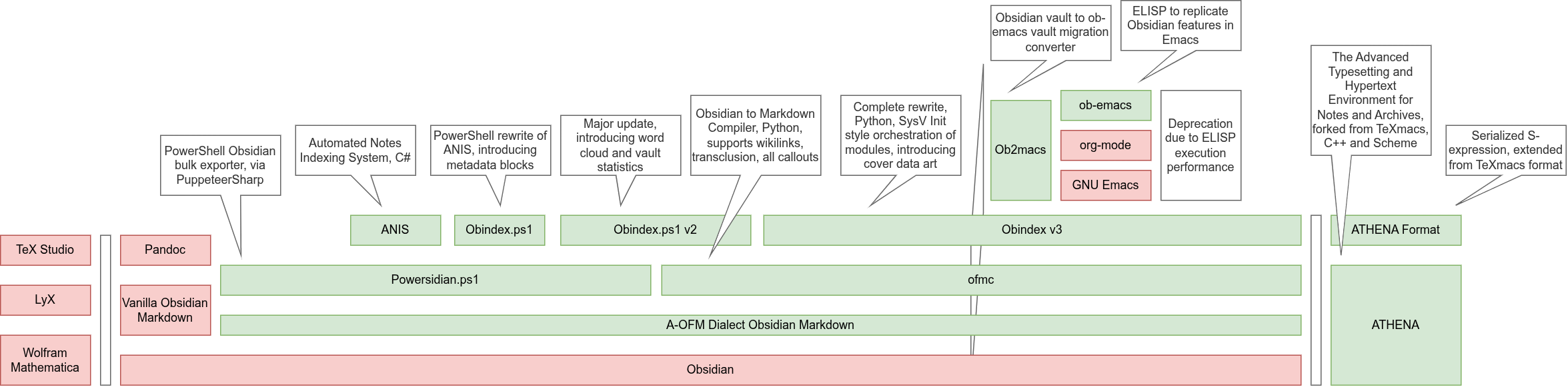
Here are some links to the predecessors of ATHENA: Powersidian and Obindex.ps1, ob-emacs and ofmc.
| The GitHub repository of ATHENA: | https://github.com/NuaptanEvalisk/ATHENA |
| ATHENA's releases: | https://github.com/NuaptanEvalisk/ATHENA/releases |
2Features
| Structured mathematical editing. | TEXmacs-based editing for definitions, theorems, proofs, formulas, and long mathematical documents, with optimizations for real-time WYSIWYG input and typesetting, native commutative diagrams, and formula AST inspection. |
| Mathematical knowledge management. | ATHENA treats a mathematical archive as a knowledge vault, not a collection of standalone documents. Using enunciation-level wikilinks and transclusions, definitions, propositions, examples and more can be referenced and reused effortlessly. |
| Namespaces. | ATHENA allows you to organize your math categorically. Namespace is such an abstraction with which you no longer face the dilemma of whether to put 'lectures notes on subject X' in the directory of 'lecture notes' or the directory of 'subject X'. |
| Publishing. | In addition to exporting LATEX documents and PDFs, with ATHENA selected parts of a vault can be exported into static websites, while retaining most of the structure. You are currently looking at one. |
| Search and navigation. | Global fuzzy structural search, neighborhoods, hierarchy and reference graphs, recent-note switching, and semantic Artifacts connect a large vault without flattening it into plain text. |
For the full list of ATHENA's features, go to ATHENA - Features. For more screenshots of ATHENA, go to ATHENA - Gallery.
3Download and Installation
Pre-compiled binaries for GNU/Linux and Microsoft Windows can be found on the GitHub releases page. Only x86_64 binaries are available. The AppImage is tested on openSUSE Tumbelweed and Ubuntu (in a distrobox container). Because I don't have any physical devices with Windows installed, the Windows binary is tested using wine and only basic smoke tests are included.
The scripted Linux release build also produces a Debian package and separate RPM packages for openSUSE-compatible and RHEL-compatible systems. AppImages remain the most distribution-independent release artifacts.
It is more recommended to compile ATHENA from source, which is available on GitHub. ATHENA is built with CMake and the Intel oneAPI C++ compiler (icpx) is the recommended compiler. Details about dependencies and building instructions can be found in the COMPILE file in the source repository.
ATHENA uses Qt 6 and supports Wayland on GNU/Linux natively. Although it should also be able to work with xcb, X11 support is not actively maintained. To make the Visual Studio-flavored docking experience possible, ATHENA patches the Qt Advanced Docking System and uses the xdg-toplevel-drag protocol, which Chromium also uses. This protocol is supported by the latest KDE and GNOME desktops.
ATHENA inherits the GUILE 1.8 dependency from GNU TEXmacs. You may obtain the source code of GUILE 1.8 here. One long-term plan of ATHENA is to eventually rewrite all Scheme code with C++ so dependence on GUILE would be removed.
4Licensing and Copyright
ATHENA is free software licensed under the GNU General Public License version 3. ATHENA is a fork of GNU TEXmacs. A substantial part of the source tree comes from GNU TEXmacs and remains copyright its original authors and contributors. ATHENA-specific modifications and additions are copyright © 2026 Nuaptan Evalisk. The GPLv3 applies to ATHENA as a software program. Documents written with ATHENA, vault contents, exported PDFs, and ATHENA-generated websites remain the property of their authors unless separately licensed.
See the ATHENA - Licensing page for full copyright information and third-party notices.
5Acknowledgments
ATHENA is possible because GNU TEXmacs already exists. TeXmacs provides the mathematical editing and structured typesetting foundation on which ATHENA is built.
The project also relies on the wider free-software ecosystem, including Qt, Qt Advanced Docking System, GUILE, SQLite, FreeType, ImageMagick, Ghostscript, llama.cpp, libtcc, and other libraries and tools used for the interface, document processing, indexing, export, and runtime infrastructure.
ATHENA is an independent fork and extension of TEXmacs. It is not an official GNU TEXmacs release.
6Contact
ATHENA is maintained by Nuaptan Evalisk.
For bug reports, technical discussion, build issues, documentation problems, or questions about ATHENA, contact [email protected].
[Source: ATHENA - Licensing.ath]
ATHENA is distributed in the hope that it will be useful, but without any warranty; without even the implied warranty of merchantability or fitness for a particular purpose. See the GNU General Public License version 3 for details.
The no-warranty warning above is an instance of transclusion.